Index Funds - The Ultimate Tool to Build Wealth
Key Highlights:
· Long-term data shows that actively managed funds don’t beat the market
· Higher fees in actively managed funds compound to large lag in returns compared to index funds
· Buying an Index fund is more than “buying the S&P 500.” Make sure you pick a fund with low fees and high trading volume. Be careful of 0% fee index funds.
Many people know to be diversified, so they choose a bunch of different mutual funds and ETFS. This could be a mistake, especially if they don’t know what type of fund they are buying. You will learn why fees you are paying are important and how costs saved from index funds will ultimately be a better choice to build wealth.
I have a friend that bought different types of ETFs and Mutual Funds. Let’s call him Bob. Bob bought a mixture of index funds and actively managed funds. Bob didn’t really know the difference between them. He bought funds based on recommendations from the internet and how they have performed in the past. Here is a quick comparison.
Index funds
· Low cost and follow the market. Average fees are 0.05% per year
· Well known funds include VOO, SPY. They follow the US stock market, the SP 500.
· They are passive. You buy and hold. It’s best to not touch them until you need to use the money.
Actively managed funds
· Higher cost and actively trying to beat the market. Average fees are 0.54% per year
· The fund managers try to pick stocks they think will grow or sell stocks before a market drop by predicting what the market will do
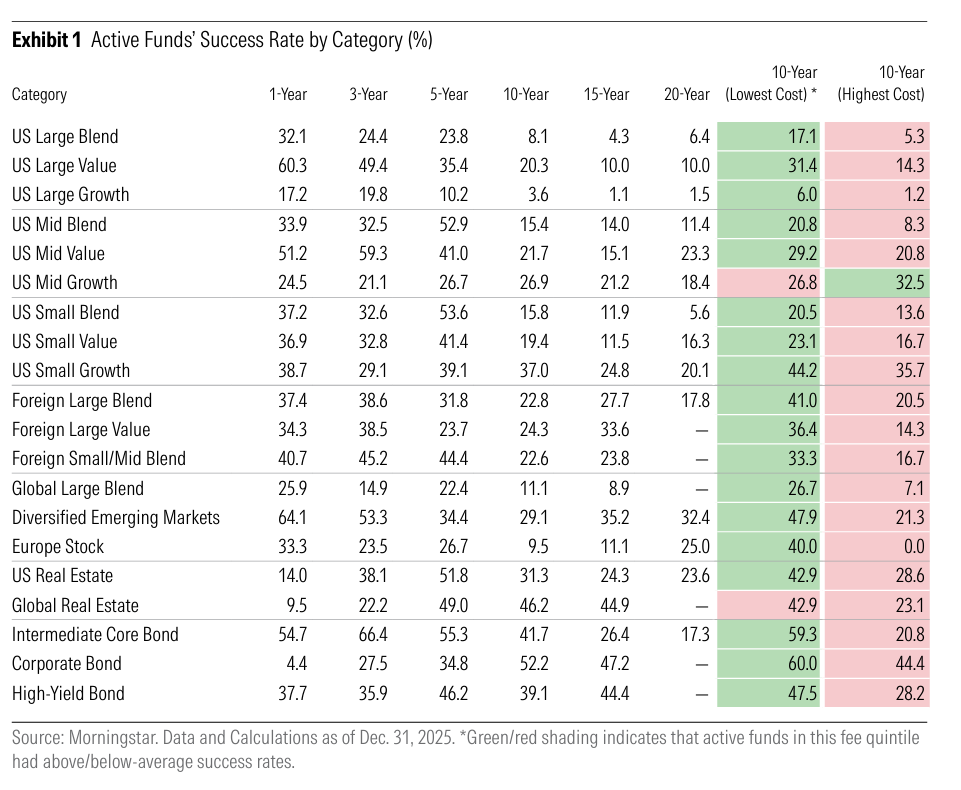
Based on the long-term data, you shouldn’t buy actively managed funds, and you should buy index funds instead. Let me show you a chart from Morningstar, a well-known research company:
Source: Morningstar’s US Active/Passive Barometer Year-End 2025
The numbers show the success rate of actively managed funds, telling us what percentage of actively managed funds beat the market. In a 20-year time frame, only 6.4% of funds beat the market in the Large Cap Blend Category. The Large Cap Blend category is similar to the SP 500 stock market. Also, the funds with the 10-year lowest costs have mostly outperformed funds with the highest costs. The data is clear that actively managed funds don’t work.
There are a couple reasons why active management doesn’t work:
1. The market is too efficient. Think of it as playing poker. You are not going to make much money if you and everyone else is using ChatGPT to know every single optimal move. Then winning is purely based on luck. In the US, almost every single piece of information is already publicly available, and so an actively managed fund does not have much have an advantage over an average investor. Long gone are the Warren Buffet days where they get proprietary information through analysis and industry contacts. That's why active managers in Diversified Emerging Markets do better compared to an active manager in US Large Blend, because emerging markets are not as efficient. In countries like China, India, Brazil, not a lot of information is not as public, and managers have more opportunity to show their skills.
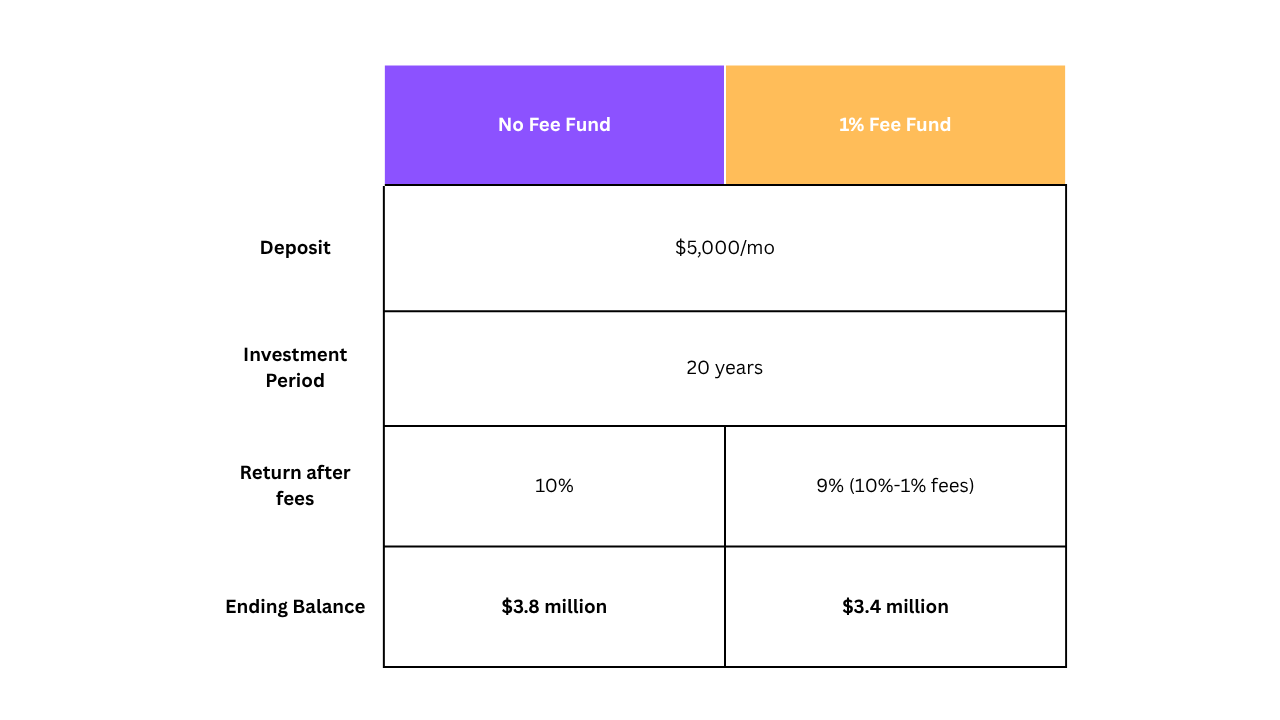
2. Higher fees from actively managed funds eat up your returns. A small difference in returns can snowball into a large difference in returns over a long time span. Let me show you how that fee difference would like in real dollars. Let’s say our friend, Bob, invested $5000 a month for 20 years in a no fee fund vs. a 1% fee fund.
No Fee Fund vs. 1% Fee Fund
That 1% difference per year led to a $400K difference for Bob. That’s the power of compounding.
Bob also should not chase funds simply because they recently posted high returns. Each year, the news highlights new winners, but picking past winners is a poor strategy. A fund’s strong performance over the last few years does not guarantee it will perform well over the next 20 years. The Morningstar 20-year data above shows how difficult it is to beat the market consistently, and I would not expect to do it myself.
That's why investing in index funds makes sense. If you can't beat the market, investing in the market as low-cost as possible would be your next best bet. There are many ETFs that have fees that are close to 0%. It is almost free to invest in index funds. Index funds are very popular nowadays, so it wouldn’t be hard to find them. You can Google the fund lineup of companies like Vanguard and BlackRock.
When I’m researching a fund, I look at the cost and the liquidity. For the cost, it shouldn’t be much higher than the index fund average of 0.05%. For liquidity, I’m looking for a fund that has high trade volume. That means a lot of people are buying and selling at the same time. If I need to buy or sell it, it would be a very easy and quick transaction. Vanguard’s funds have very high trade volume because it’s so popular.
There are some index funds out there that literally have zero fees. I would usually avoid it, because sometimes you can’t move those funds to a different broker in the future. I would rather pick a fund that is more liquid and transferrable with higher fees.
When you buy index funds, make sure you know what market you are buying. There are so many types of markets to choose from. You can choose by geography like the US market or international. You can also choose between the size of the company (large cap, small cap) or industries (tech, consumer goods). Each of these different types of index funds have different risks and returns. It might be good to invest in a combination of these to be diversified. Make sure you know the differences or hire someone to help you.
Next steps
Double check which of your funds are index or actively managed funds
Confirm the expenses of the funds
If you are switching to an index fund, research what type of fund you are buying (US vs. International. Large cap vs. small cap)
This article is only for educational purposes only and should not be considered financial recommendation.