Should Doctors Use Trump Accounts for Their Kids?
Key Takeaways
It’s best that the parent opens the Trump account and only account is allowed for each child.
Trump Accounts are the least tax-efficient among other children accounts because parents cannot get a tax deduction and growth is taxed at ordinary income.
Converting the Trump account to a Roth IRA after the child turns 18 could make the Trump Account worth it if you maxed out other account types.
Beware of the potential traps of the Trump accounts: you can only invest in US index funds and there are very limited withdrawal options before the child is 18.
The Trump Accounts have been getting a lot of headlines from its $1,000 funding to newborn babies. It is now officially available to use on July 4th. The trump accounts have unique features that are very different than other children accounts, like custodian Roth IRAs, 529s, and taxable accounts. In this article, you will learn how the Trump accounts work and whether it is worth it compared to other account types for your child
Trump Account Basics
Opening the Account
The Trump account is technically an IRA (Individual Retirement Account) for children. It allows you to contribute funds into your child’s retirement without needing the child to earn a salary. Here are the basic requirements for opening an account for your child:
1. You can only open this for a child under age 18.
2. The account will be under the child's name.
3. Each child may have only one Trump account.
When you open an account for your child, you are managing the account for them for their benefit. Once you contribute money to their account, you cannot take it out and put it back into your bank account. You also want to make sure that only one account is opened for the child. The grandparents might unknowingly open an additional account for their grandkid. Even though the intention was admirable, it would be best for parents to open the account and have the grandparents contribute to the account directly.
Growth Period Rules
There are additional rules on withdrawals and taxes. These rules are split between two time periods. The Trump account follows a more stringent set of rules before December 31 of the calendar year in which the account beneficiary turns 17 (the year before they turn 18). That is called the Growth Period. After that, the account follows less stringent traditional IRA rules.
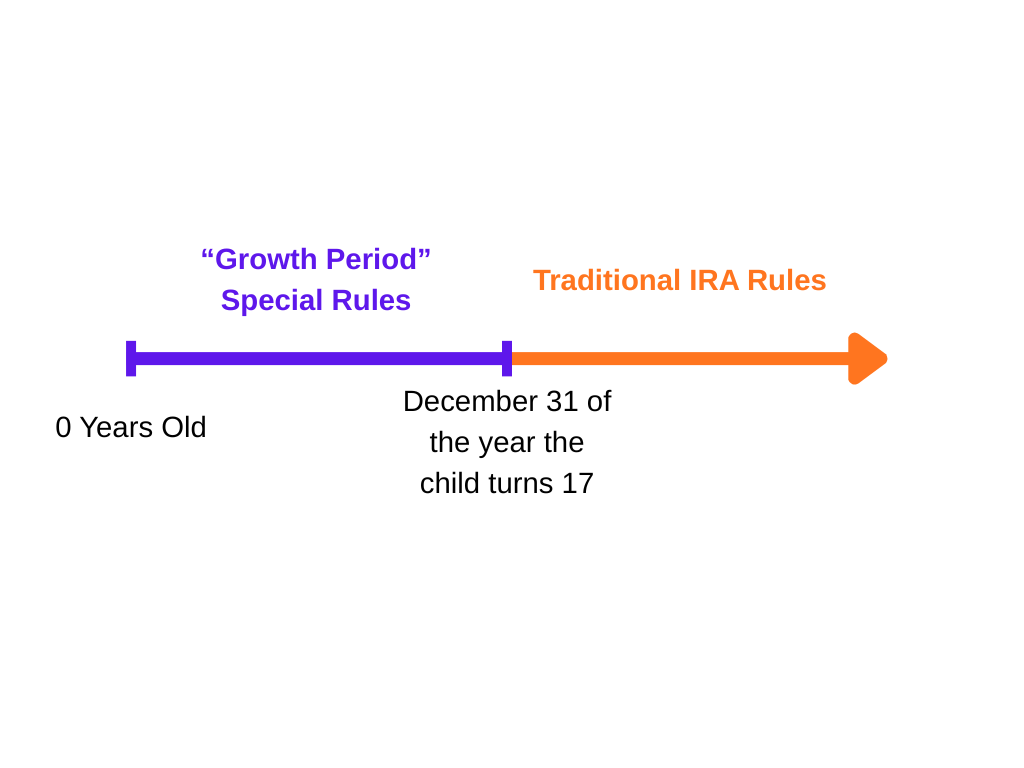
Growth Period vs. Traditional IRA Rules
Let’s compare the differences between the rules of the Growth Period and Traditional IRA Rules.
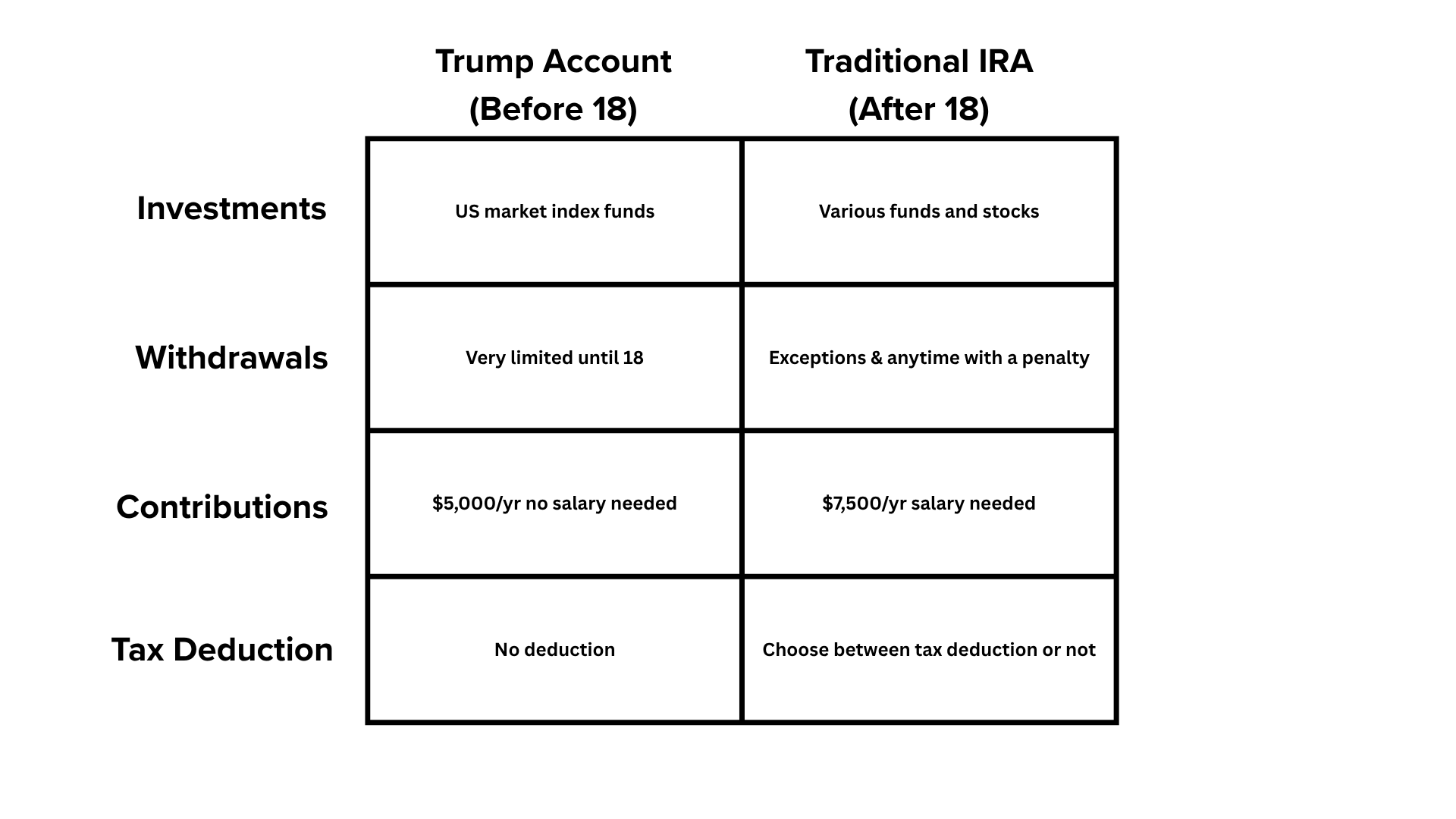
Trump Account Rules (Before 18) vs. Traditional IRA Rules (After 18)
Investments: Trump accounts only allow investing in US index funds in trump accounts. Traditional IRAs provide much more flexibility in allowing different types of markets like international markets and stocks.
Withdraws: Before 18, you can only withdraw by (1) transferring to a different Trump Account, (2) rollover to an ABLE account if your child is disabled, or (3) at death. You can't take out funds for any other reason even if you are willing to pay a penalty for it. That's different to the traditional IRA where you have special exceptions and you can take out funds by paying a penalty. Once the child is 59.5 years old, they are able to withdraw from the account without penalties.
Contribution limits: You can contribute $5,000 per year for each child before 18. The kid does not need to earn a salary to contribute. Once the kid turns 18, the kid would need to earn a salary to contribute up to $7500.
Tax Deduction: When you contribute to your kid's trump account before 18, there is no tax deduction like an IRA. That portion will not be taxed when the kid uses it for retirement. The growth in the accounts will be taxed. It is taxed as ordinary income, which may not be ideal in some situations that I'll explain in the tax section later.
$1,000 Pilot Program
The $1,000 contribution from the federal government is one of the biggest reason to open the trump accounts, but there are a couple rules that you need to satisfy:
Your child has to be born between January 1, 2025, and December 31, 2028. Kids born before that don’t qualify.
The child must be a US citizen
The child must be a “Qualified Child” under the IRS rules.
What are the Qualified Child Rules?
Your child must past through five tests. This article from TaxSlayer explains this well. The most common rules that people make mistakes on are these:
The person who opens the account must be a certain family member like a parent or grandparent. You don't want to be opening trump accounts for a friend's kid or your godchild.
The person that opens the account must live with the child. That's why I recommend a direct parent to open the account instead of grandparents.
If your child qualifies, this would be a no brainer to open the account to get free money. It's also a nice way to teach your kids about saving for retirement. The $1000 is also not taxable to you and the taxes are not paid until your kid takes it out. You would need to manage an additional account since you can’t merge the Trump account with other account types until the Child turns 18.
Tax Benefits
Even if your child is not a newborn baby, there still is an opportunity to contribute $5000 a year from your own money. Here is the big question: is it worth it to put money in Trump accounts over other types of kid accounts, such as Roth IRAs, 529s, and taxable accounts? In the graph below, I invested $5,000 for a newborn child and compared how they would grow after accounting for taxes.
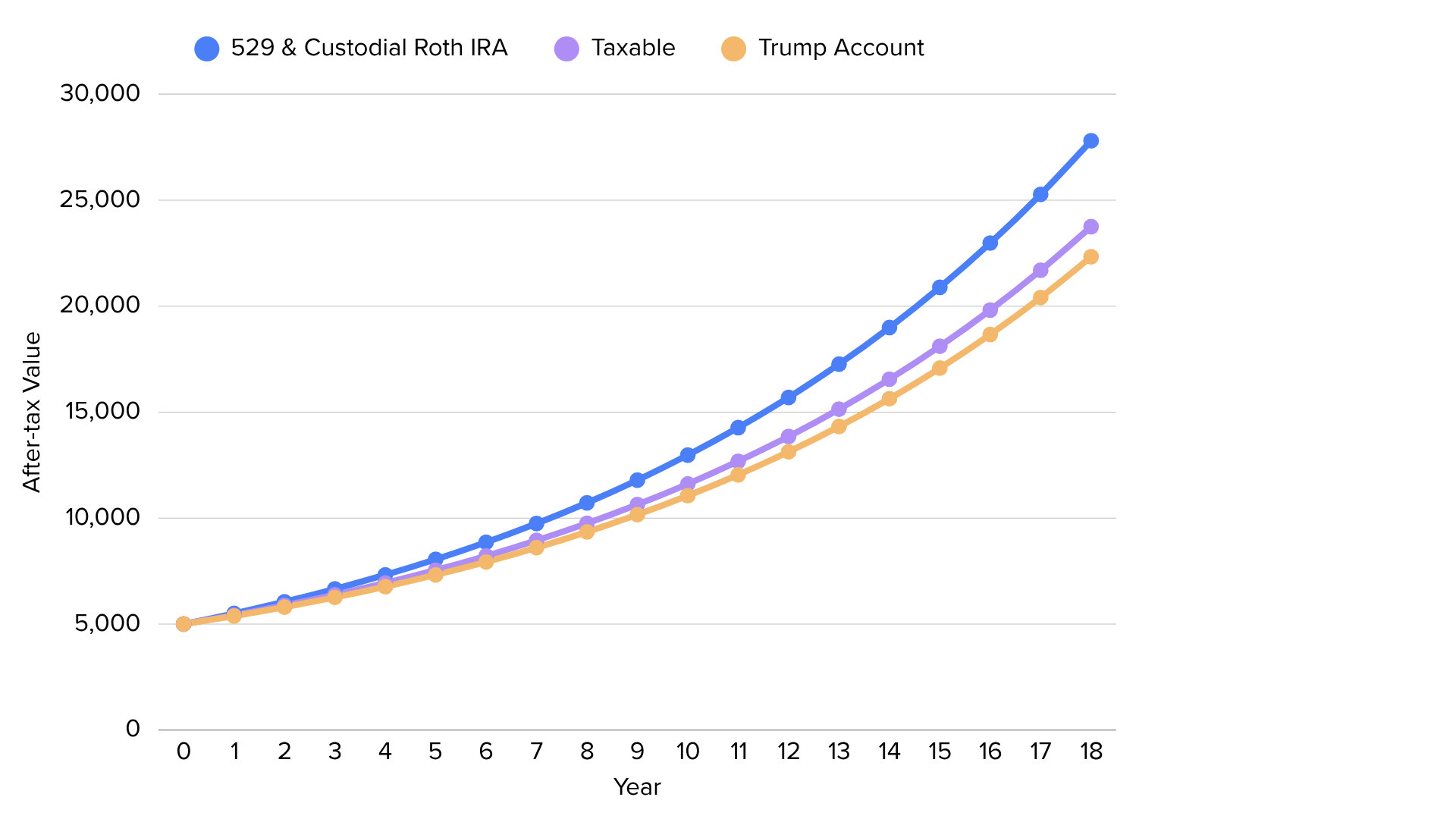
After-tax value of different account types for children. $5000 invested growing @10%/yr, accounting for tax-drag of taxable accounts
Tax Efficiency Comparison
Best: 529s and Roth IRAs
Earnings are tax free. Compounding the growth over many years makes the tax benefits even better. *The child must earn a salary to be able to contribute to a Roth IRA (not many babies work)
Mid: Taxable accounts
Tax accounts are normally not tax efficient because they have an annual tax drag, meaning you have to pay taxes on dividends and capital gains every year, but they are good because you pay capital gains taxes at much lower rates if you hold your investments for over a year.
Worst: Trump Accounts
The Trump accounts are the least tax efficient because you don't get any tax deductions when you put your money in the account like an IRA. Also, when the child withdraws from the account, they are taxed as ordinary income, which are worse rates than capital gains from a taxable account.
The difference between ordinary income and capital gains can be very high if your kid is wealthy at retirement. Ordinary income has much higher tax brackets compared than tax brackets of capital gains. For ordinary income, the highest tax bracket is 37%. For long-term capital gains, the highest tax bracket is at most 20%. That's a 17% difference!
The Roth Conversion Workaround
There is a strategy that could make Trump accounts a viable strategy. You can potentially convert the funds in the Trump account to a Roth IRA so your kid can benefit from tax free growth. This can only be done with traditional IRA rules. That means you have to wait until the kid is close to 18 years old to convert the funds into a Roth IRA. The amount converted counts as ordinary income to the kid, which could be an opportunity if the child is at a low tax bracket. Maybe they go to med school like you. Then they could convert at a low tax bracket as low as 10%. With the Roth conversion, you are trading off paying taxes now, reducing the amount you can invest initially, and hope that the tax-free benefits make it worthwhile. The Roth conversion strategy starts to be better than investing in a taxable account after year 14 in this example. The child would likely be in their 30s by that time, which means that they have 30 more years for growth that will make the Roth IRA tax benefits even better.
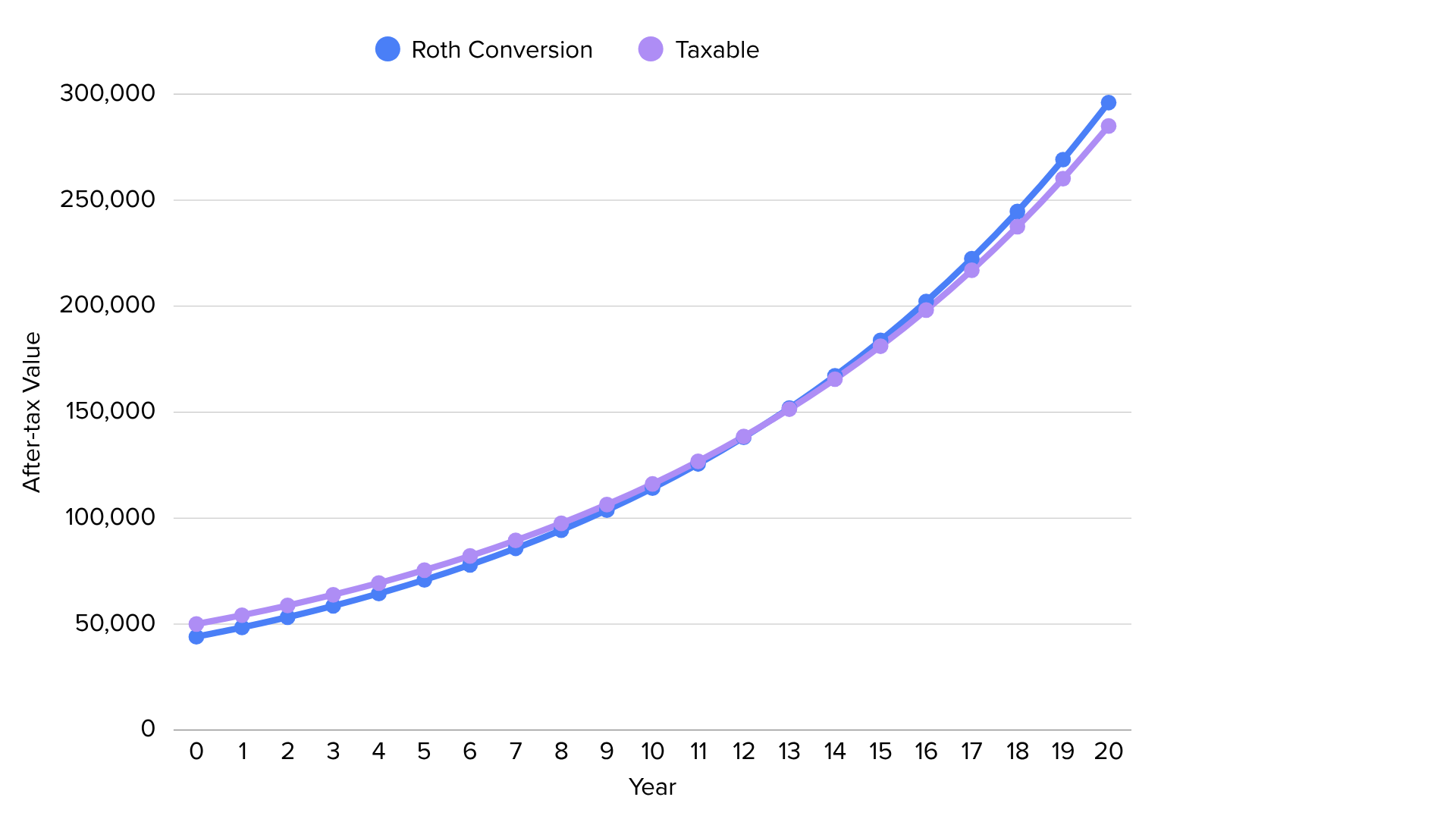
$50,000 Trump Account converted to Roth IRA vs. $50,000 Taxable account, growing at 10%/yr
Investment Flexibility
Mentioned in the Trump Basics section, the Trump account is only limited to US Market Index Funds. Here is the lineup of Funds that are currently approved.
State Street SPDR Portfolio S&P 500 ETF (SPYM)
iShares Core S&P 500 ETF (IVV)
Vanguard Total Stock Market ETF (VTI)
State Street SPDR Portfolio S&P 1500 Composite Stock Market ETF (SPTM)
iShares Core S&P total U.S. Stock Market ETF (ITOT)
Here are things that are not allowed: stocks, margin, International index funds.
It’s disappointing that international index funds are not allowed. Being able to invest in different markets in Diversification 101. I believe the government is more worried about increasing prices in the US market than fully looking out for the investor. There is a reason that 401K plans are required to have at least three diversified options for investments. The regulations prevent people from going all in one type of investment. There have been long periods of poor performing US market returns between 2000 to 2009. Between January 2000 to Dec 2009, the SP 500 had an annual return of -0.95%. In theory, investors should keep holding the funds even if markets are down because of the very long investment horizon for kids. However, we shouldn’t deny the fact that we might be putting unnecessary risk to our children’s retirement due to the lack of diversification.
Investment Flexibility Comparison
Best: Roth IRA & Taxable
Allows you to invest in stocks and choose almost any mutual fund or ETF.
Mid: 529
You can't invest in stocks, but you can still pick from a menu of investment funds
Worst: Trump account
US Index Funds only
Withdrawal Flexibility
Since the Trump account is built to help for your child’s retirement, typically the child needs to wait until 59.5 years old to withdraw without penalties. Outside of retirement, there are very limited ways to withdraw from the account. Before 18, you can only withdraw by (1) transferring to a different Trump Account, (2) rollover to an ABLE account if your child is disabled, or (3) at death.
This unusually strict withdrawal restriction could catch people off guard in the future. What if you really need the money and can't access it? What if your kid is terminally ill and you need the funds from the trump accounts to pay for expenses? If the funds were in a Roth IRA, 529, you would still be able to pull the funds out, maybe for a penalty, but at least you have access to them.
Withdrawal Flexibility Comparison
Best: Taxable
No restrictions. You can withdraw from the account anytime without penalties
Mid: Roth IRA
May withdraw before 59.5 years old, but growth in the account are taxed and penalized
Mid: 529
May withdraw if funds are not used for education expenses, but growth in the account are taxed and penalized
Worst: Trump account
No option to withdraw before age 18 at a penalty
Final Verdict
Overall, if you are not able to get the $1,000 contribution from the federal government, the Trump is one of the least useful accounts compared to other accounts for children. It is neither tax efficient nor flexible. It could be justified if you are expecting to convert to a Roth IRA after the child turns 18 years old. This may still be an option to consider if you have additional savings and you’ve already maxed out your other account types. to Here is how I would prioritize. Your personal situation may make an account more valuable than the other.
Roth IRA (child must have a salary)
529
Trump Account with Roth conversions
Taxable Account
Trump Account without Roth conversions
This article is for educational purposes only and should not be considered individualized financial, tax, legal, or investment advice.